Empowering Cancer Care with AI: A Jefferson Medical Student–Led Innovation

I’m excited to share a new collaborative study I had the privilege of co-authoring, which was recently published in Nutrients. Led by Jefferson medical student Julia Logan, this work explores how large language models (LLMs) like ChatGPT and Gemini can deliver accessible, culturally sensitive dietary advice to cancer patients—many of whom lack access to professional nutritional counseling due to insurance limitations or socioeconomic barriers. ...
April 8, 2025 · 1 min · 153 words · Wookjin Choi

AI-Powered Auto-Segmentation in Liver Cancer Therapy

We’re excited to share our latest work published in Technology in Cancer Research & Treatment: “Deep Learning-Based Auto-Segmentation for Liver Yttrium-90 Selective Internal Radiation Therapy” — a collaboration between Jun Li, Rani Anne, and myself. This study introduces a deep learning (DL) model built on the 3D U-Net architecture, developed to automatically segment the liver in CT scans for patients undergoing Y-90 Selective Internal Radiation Therapy (SIRT). Accurate liver segmentation is a critical step for calculating Y-90 dosage, traditionally done manually — a time-consuming and subjective process. ...

April 8, 2025 · 1 min · 142 words · Wookjin Choi

Clinically-Interpretable Radiomics

MICCAI'22 Paper | CMPB'21 Paper | CIRDataset This library serves as a one-stop solution for analyzing datasets using clinically-interpretable radiomics (CIR) in cancer imaging (https://github.com/choilab-jefferson/CIR). The primary motivation for this comes from our collaborators in radiology and radiation oncology inquiring about the importance of clinically-reported features in state-of-the-art deep learning malignancy/recurrence/treatment response prediction algorithms. Previous methods have performed such prediction tasks but without robust attribution to any clinically reported/actionable features (see extensive literature on the sensitivity of attribution methods to hyperparameters). This motivated us to curate datasets by annotating clinically-reported features at the voxel/vertex level on public datasets (using our published advanced mathematical algorithms) and relating these to prediction tasks (bypassing the “flaky” attribution schemes). With the release of these comprehensively-annotated datasets, we hope that previous malignancy prediction methods can also validate their explanations and provide clinically-actionable insights. We also provide strong end-to-end baselines for extracting these hard-to-compute clinically-reported features and using these in different prediction tasks. ...

June 29, 2022 · 5 min · 1002 words · Wookjin Choi

PathCNN: interpretable convolutional neural networks for survival prediction and pathway analysis applied to glioblastoma

Jung Hun Oh, Wookjin Choi, Euiseong Ko, Mingon Kang, Allen Tannenbaum, Joseph O Deasy The authors wish it to be known that, in their opinion, Jung Hun Oh and Wookjin Choi should be regarded as Joint First Authors. https://academic.oup.com/bioinformatics/article/37/Supplement_1/i443/6319702 https://github.com/mskspi/PathCNN/raw/main/img/pathcnn.png An illustration of biological interpretation. (A) Grad-CAM procedure to generate class activation maps. The two images on the left bottom represent an example of the class activation maps for a sample in the cohort, which were generated from Grad-CAM procedure; (B) statistical analysis to identify significantly different pathways between the LTS and non-LTS groups. LTS, long-term survival; CNN, convolutional neural network; ReLU, rectified linear unit ...

July 22, 2021 · 2 min · 286 words · Wookjin Choi

Reproducible and Interpretable Spiculation Quantification for Lung Cancer Screening

Choi, W., Nadeem, S., Alam, S. R., Deasy, J. O., Tannenbaum, A., & Lu, W. (2020). Reproducible and Interpretable Spiculation Quantification for Lung Cancer Screening. Computer Methods and Programs in Biomedicine, 105839. https://doi.org/10.1016/j.cmpb.2020.105839 Source codes: https://github.com/choilab-jefferson/LungCancerScreeningRadiomics Highlights A novel interpretable spiculation feature is presented, computed using the area distortion metric from spherical conformal (angle-preserving) parameterization. A simple one-step feature and prediction model is introduced which only uses our interpretable features (size, spiculation, lobulation, vessel/wall attachment) and has the added advantage of using weak-labeled training data. ...

November 17, 2020 · 3 min · 451 words · Wookjin Choi

Aggressive Lung Adenocarcinoma Subtype Prediction Using FDG-PET/CT Radiomics

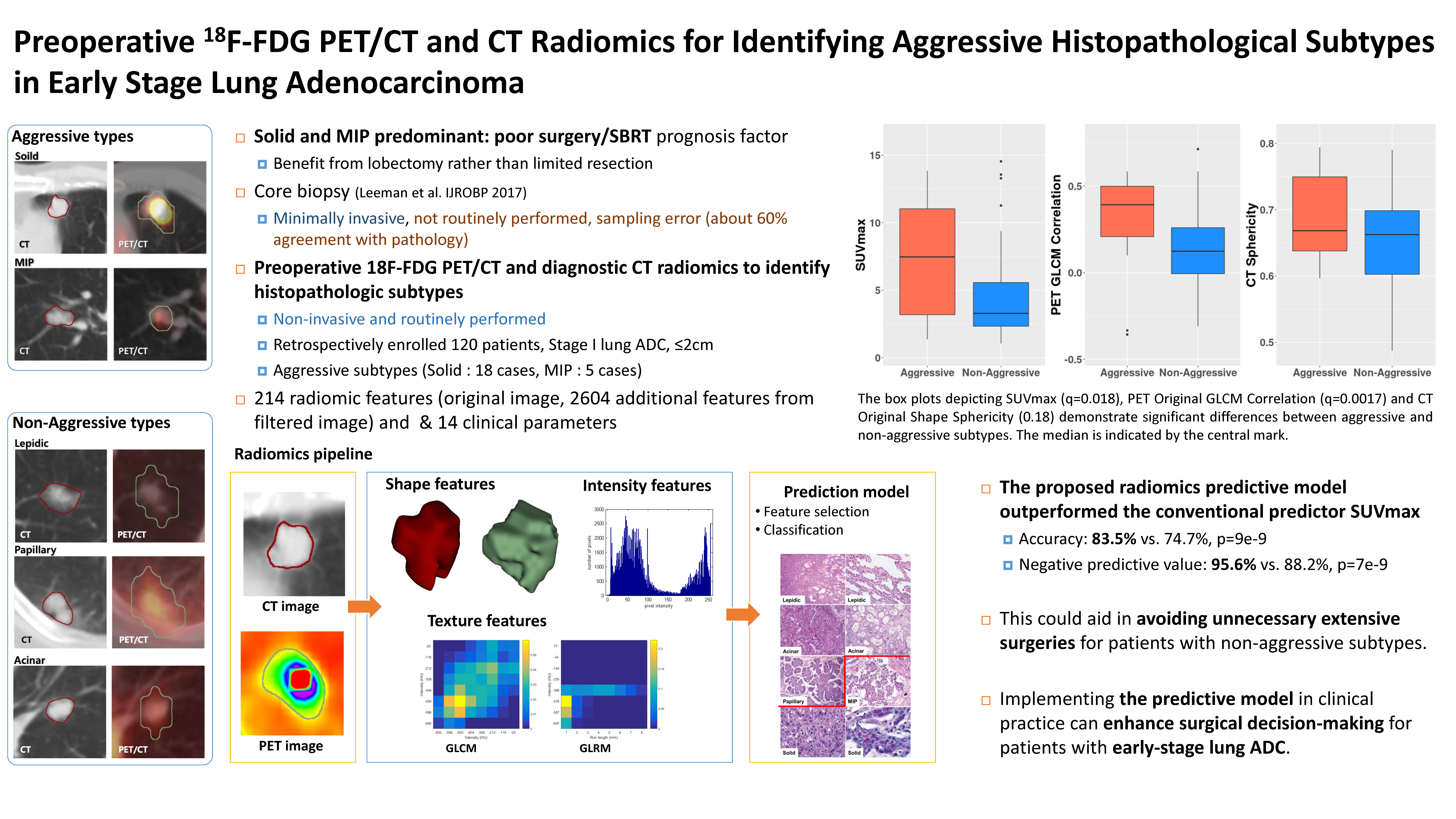
This paper has been published in the Computational and Structural Biotechnology Journal. Preoperative 18F-FDG PET/CT and CT radiomics for identifying aggressive histopathological subtypes in early stage lung adenocarcinoma Wookjin Choi a d1, Chia-Ju Liu b 1, Sadegh Riyahi Alam a, Jung Hun Oh a, Raj Vaghjiani c, John Humm a, Wolfgang Weber b, Prasad S. Adusumilli c, Joseph O. Deasy a, Wei Lu a a Department of Medical Physics, Memorial Sloan Kettering Cancer Center, New York, NY 10065, USA b Department of Radiology, Memorial Sloan Kettering Cancer Center, New York, NY 10065, USA c Department of Surgery, Memorial Sloan Kettering Cancer Center, New York, NY 10065, USA d Department of Radiation Oncology, Thomas Jefferson University, Philadelphia, PA 19107, USA ...

August 1, 2017 · 2 min · 390 words · Wookjin Choi