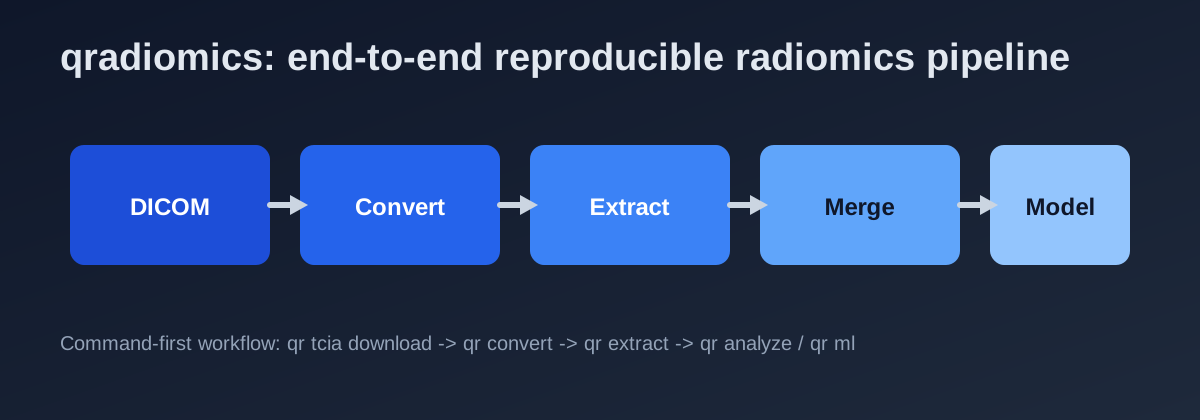
We are releasing qradiomics — an open-source Python CLI that unifies more than a decade of Choi Lab radiomics work into a single, reproducible, pip-installable toolkit.
What is qradiomics?
qradiomics (command: qr) is a radiomics research CLI built for the full data flow from raw DICOM to published-grade results:
DICOM download → conversion → feature extraction → clinical merge → modeling
Each step is a single Unix-style command. Pipelines are assembled from those atomic commands using plain JSON plans, executed by Nextflow (per-patient parallel), Prefect, or inline. One command gets you started:
curl -sSL https://raw.githubusercontent.com/choilab-jefferson/qradiomics/main/scripts/kickoff.sh | bash
Three earlier projects, unified
qradiomics is the direct successor of three Choi Lab codebases that are now retired:
| Earlier project | Stack | Status |
|---|---|---|
| taznux/lung-image-analysis | MATLAB | superseded |
| taznux/radiomics-tools | C++ / ITK / Ruffus | superseded |
| choilab-jefferson/LungCancerScreeningRadiomics | MATLAB / Python | superseded |
The feature extractors, spiculation pipeline, and LIDC-IDRI workflow from all three are now available as pure Python under a single MIT-licensed package.
Reproducibility: published results re-confirmed
One of the primary goals of qradiomics is to make published results independently verifiable. Running the bundled pipelines on public TCIA datasets reproduces — or exceeds — the numbers from four peer-reviewed papers:
| Paper | Method | Our result | Published |
|---|---|---|---|
| Choi 2018 Med Phys | radiomics50 | AUC 0.872 ± 0.010 | 0.83 – 0.95 |
| Choi 2021 CMPB — spic6 only | 6 spiculation features | AUC 0.816 ± 0.006 | 0.80 – 0.85 |
| Choi 2021 CMPB — PM (CIR masks) | radiomics + spic | AUC 0.868 ± 0.039 | 0.85 |
| Choi 2021 CMPB — LUNGx external | radiomics50 + calibration | AUC 0.756 | 0.76 |
The LUNGx external validation result (AUC 0.756) matches the published number exactly using only interpretable hand-crafted features — no neural-network encoder required.
Key features
qr tcia download— bulk-pull any TCIA collection with multi-process progressqr convert dicom-series / rtstruct— DICOM CT/PET/MR + RTSTRUCT → NRRD (SUV-corrected for PET, case-insensitive ROI lookup)qr extract— PyRadiomics with bundled pattern templates (nsclc-survival,ct-default, …)qr analyze survival / classify / importance— Cox PH, logistic regression, random-forest feature importanceqr ml train / predict / evaluate— leakage-safe cross-validated model buildingqr workflow plan / scaffold / run— Nextflow / Prefect / inline pipeline assemblyqr anonymize— strip PHI from DICOM trees (PS3.15 Annex E)qradiomics.shape— Python re-implementations of the Choi 2014 AHSN nodule detector and Choi 2021 spiculation quantifier
Validated on four public cohorts
The same pipeline has been validated end-to-end on TCIA data:
- NSCLC-Radiomics (Lung1) — Aerts 2014 discovery cohort (n=420) — open access
- LIDC-IDRI — full 1,018-scan reference benchmark — open access
- NSCLC-Cetuximab — external validation (n=460) — available via NCI data access agreement
- ACRIN-NSCLC-FDG-PET — PET/CT with cardiac and pulmonary ROIs — open access
Get started
# Install
pip install -e .[rtstruct]

# One-liner smoke test (synthetic data, no download required)
python scripts/smoke.py

# Full Lung1 end-to-end (~1 h on 16 cores)
qr tcia download --collection NSCLC-Radiomics --modality CT -o /data/Lung1 -j 16
Full documentation: ../../projects/2026-05-17-qradiomics/
Source code: github.com/choilab-jefferson/qradiomics
Broader Choi Lab research — all publicly available
qradiomics is the computational backbone, but the lab’s research portfolio covers several active fronts. All of the following are fully public.
Interpretable spiculation quantification (Choi 2021, CMPB)
A reproducible, geometry-based algorithm for quantifying nodule spiculation in CT — one of the most diagnostically important features for lung cancer malignancy assessment. Available as qradiomics.shape. Paper: doi:10.1016/j.cmpb.2020.105839.
Functional radiomics: cardiac PET in lung cancer RT (Choi 2023 / 2024)
A novel functional radiomics method that uses serial cardiac FDG-PET uptake as a surrogate of radiation-induced cardiotoxicity. Featured in a JCO Clinical Cancer Informatics editorial.
Posts: Novel Functional Delta-Radiomics (AAPM/ASTRO 2023) · JCO CCI editorial (2024)
Looking back — and forward
The first radiomics code from this lab was written in MATLAB in 2012. Since then, the stack evolved through C++/ITK (radiomics-tools), through separate MATLAB+Python scripts (LungCancerScreeningRadiomics), and is now a single Python package with automated pipelines, leakage-safe modeling, and full TCIA integration.
The pipeline was first presented publicly at AAPM 2025 (Washington, DC, Jul 27), validated on 207 institutional lung cancer patients (340 GTVs) and the TCIA NSCLC-Radiomics (Lung1) cohort (422 patients). The study demonstrated end-to-end automation — CT/RTSTRUCT/RTDOSE conversion, PyRadiomics extraction, and Prefect-orchestrated inference — processing the full Lung1 dataset in under 20 minutes:
Bhetwal P, Dichmann M, Ghimire R, Chen Y, Vinogradskiy Y, Werner-Wasik M, Dicker A, Choi W.
Development and Validation of a Scalable Radiomics Pipeline for Lung Cancer Research Using Clinical and Public Datasets (SU-1015-202-4).
Medical Physics 52(10):e700597, AAPM 2025.
A companion study presented at ASTRO 2025 applied the same pipeline to survival modeling across a 629-patient multi-institutional cohort (207 institutional + 422 TCIA Lung1), combining clinical and radiomic features with Cox PH models. Integrating radiomics with clinical variables improved overall survival prediction from C-index 0.50–0.56 (clinical-only) to 0.57–0.69. The institutional portion uses private clinical data; the TCIA Lung1 component is fully reproducible with qradiomics:
Bhetwal P, Dichmann M, Ghimire R, Chen Y, Vinogradskiy Y, Werner-Wasik M, Dicker AP, Choi W.
Integrating Clinical and Radiomic Features for Enhanced Prognostic Modeling for Lung Cancer Survival.
IJROBP 123(1):e719, ASTRO 2025. doi:10.1016/S0360-3016(25)03724-1
The open-source release arrives roughly nine months after those presentations. The public release of qradiomics marks the point where reproducibility is no longer an afterthought — every result in our past papers can be re-run with one command on publicly available data.
Full documentation: ../../projects/2026-05-17-qradiomics/
Source code: github.com/choilab-jefferson/qradiomics
Choi Lab, Department of Radiation Oncology, Sidney Kimmel Medical College at Thomas Jefferson University.