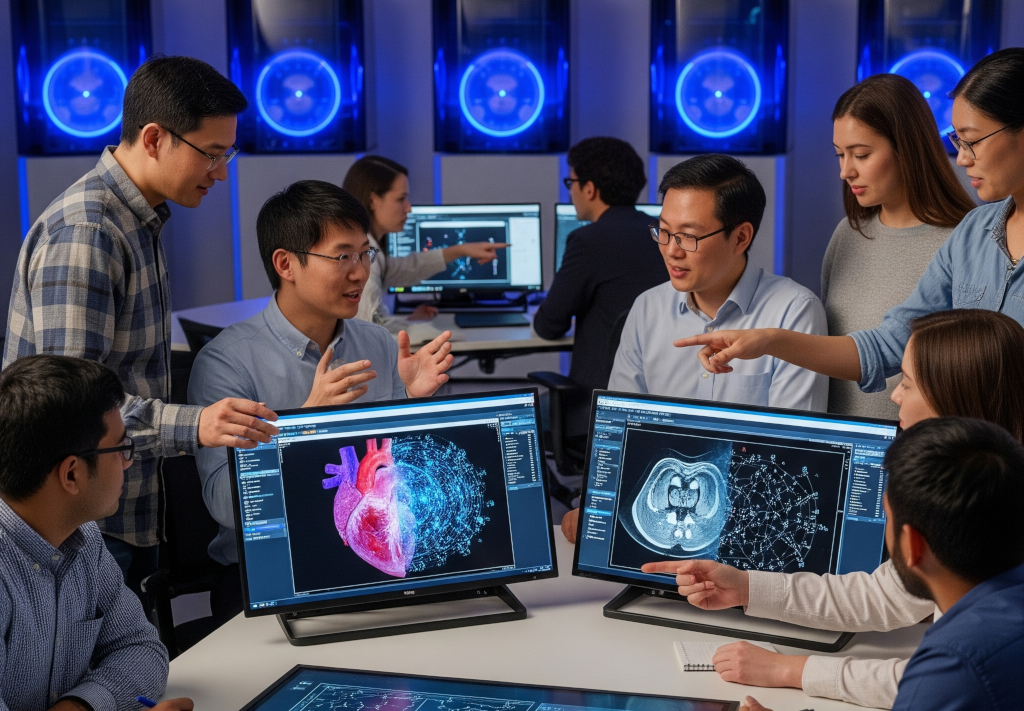
Team Quantum Heart Wins NIH Prize for Innovation

https://datascience.nih.gov/tools-and-analytics/quantum-computing-new-frontiers-biomedical-research-innovation-lab Last December, I had the incredible opportunity to be part of something truly special. The NIH Office of Data Science Strategy (ODSS) and the National Cancer Institute (NCI) gathered 27 of us from wildly different fields for a five-day Innovation Lab. The goal? To answer a question that sounds like science fiction: How can quantum computing solve today’s most complex biomedical challenges? The room buzzed with a vibrant mix of quantum physicists, computer scientists (both quantum and traditional computing), computational physicists, computational biologists, data scientists, and biomedical researchers. For five intense days, we were immersed in a whirlwind of collaboration, brainstorming, and problem-solving. The energy was electric as we united to bridge the gap between our disciplines and forge new paths for the future of medicine. ...

August 20, 2025 · 2 min · 406 words · Wookjin Choi

AI-Powered Auto-Segmentation in Liver Cancer Therapy

We’re excited to share our latest work published in Technology in Cancer Research & Treatment: “Deep Learning-Based Auto-Segmentation for Liver Yttrium-90 Selective Internal Radiation Therapy” — a collaboration between Jun Li, Rani Anne, and myself. This study introduces a deep learning (DL) model built on the 3D U-Net architecture, developed to automatically segment the liver in CT scans for patients undergoing Y-90 Selective Internal Radiation Therapy (SIRT). Accurate liver segmentation is a critical step for calculating Y-90 dosage, traditionally done manually — a time-consuming and subjective process. ...

April 8, 2025 · 1 min · 142 words · Wookjin Choi

Exploring published and novel pre-treatment CT and PET radiomics to stratify risk of progression among early-stage non-small cell lung cancer patients treated with stereotactic radiation

Maria Thor 1,4, Kelly Fitzgerald 2,4, Aditya Apte 1, Jung Hun Oh 1, Aditi Iyer 1, Otasowie Odiase 2, Saad Nadeem 1, Ellen D. Yorke 1, Jamie Chaft 3, Abraham J. Wu 2, Michael Offin 3, Charles B Simone II 2, Isabel Preeshagul 3, Daphna Y. Gelblum 2, Daniel Gomez 2, Joseph O. Deasy 1, Andreas Rimner 2 1Department of Medical Physics, Memorial Sloan Kettering Cancer Center 2Department of Radiation Oncology, Memorial Sloan Kettering Cancer Center 3Department of Medicine, Memorial Sloan Kettering Cancer Center ...

November 7, 2023 · 2 min · 271 words · Wookjin Choi

2023 Accepted/Invited Annual Meeting abstracts

AAPM Annual Meeting (Houston, TX • July 23 ‒ 27, 2023) Novel Functional Delta-Radiomics for Predicting Overall Survival in Lung Cancer Radiotherapy Using Cardiac FDG-PET Uptake Wookjin Choi, Yevgeniy Vinogradskiy Interactive ePoster Discussions: Sunday, July 23, 2023: 3:00 PM - 3:30 PM, GRBCC, Exhibit Hall | Forum 6 SU-300-IePD-F6-4 Novel Functional Delta-Radiomics for Predicting Overall Survival in Lung Cancer Radiotherapy Using Cardiac FDG-PET Uptake Deep Learning Segmentation for Accurate GTV and OAR Segmentation in MR-Guided Adaptive Radiotherapy for Pancreatic Cancer Patients Wookjin Choi, Hamidreza Nourzadeh, Yingxuan Chen, Christopher G. Ainsley, Vimal K. Desai, Alexander A. Kubli, Yevgeniy Vinogradskiy, Maria Werner-Wasik, Adam Mueller, and Karen E. Mooney PO-GePV-D-50 Deep Learning Segmentation for Accurate GTV and OAR Segmentation in MR-Guided Adaptive Radiotherapy for Pancreatic Cancer Patients ...

May 8, 2023 · 3 min · 488 words · Wookjin Choi

Longitudinal CBCT radiomics in Lung Cancer supported by Varian Medical Systems Inc.

Varian will support my research project entitled “Longitudinal CBCT radiomics analysis for lung cancer radiotherapy response and prognosis prediction” with $230,000 over 2 years. This is the first research grant from Varian to the Department of Radiation Oncology, Sidney Kimmel Medical College at Thomas Jefferson University. This project can potentially impact the clinical practice of lung cancer patients by using standard imaging modalities (CBCT and 4D-CBCT) to provide early prediction of prognosis and toxicity. ...

February 10, 2023 · 2 min · 233 words · Wookjin Choi

Clinically-Interpretable Radiomics

MICCAI'22 Paper | CMPB'21 Paper | CIRDataset This library serves as a one-stop solution for analyzing datasets using clinically-interpretable radiomics (CIR) in cancer imaging (https://github.com/choilab-jefferson/CIR). The primary motivation for this comes from our collaborators in radiology and radiation oncology inquiring about the importance of clinically-reported features in state-of-the-art deep learning malignancy/recurrence/treatment response prediction algorithms. Previous methods have performed such prediction tasks but without robust attribution to any clinically reported/actionable features (see extensive literature on the sensitivity of attribution methods to hyperparameters). This motivated us to curate datasets by annotating clinically-reported features at the voxel/vertex level on public datasets (using our published advanced mathematical algorithms) and relating these to prediction tasks (bypassing the “flaky” attribution schemes). With the release of these comprehensively-annotated datasets, we hope that previous malignancy prediction methods can also validate their explanations and provide clinically-actionable insights. We also provide strong end-to-end baselines for extracting these hard-to-compute clinically-reported features and using these in different prediction tasks. ...

June 29, 2022 · 5 min · 1002 words · Wookjin Choi

Lung Cancer Screening Radiomics

A comprehensive framework for lung cancer screening radiomics using LIDC-IDRI and LUNGx dataset. Data preprocessing - download data, conversion, etc. Radiomics feature extraction including spiculation features AutoML model building and validation Source code https://github.com/choilab-jefferson/LungCancerScreeningRadiomics Publications Wookjin Choi, Jung Hun Oh, Sadegh Riyahi, Chia-Ju Liu, Feng Jiang, Wengen Chen, Charles White, Andreas Rimner, James G. Mechalakos, Joseph O. Deasy, and Wei Lu, “Radiomics analysis of pulmonary nodules in low-dose CT for early detection of lung cancer”, Medical Physics, Vol. 45, No. 4, pp. 1537-1549, April 2018. https://doi.org/10.1002/mp.12820 Wookjin Choi, Saad Nadeem, Sadegh Riyahi, Joseph O. Deasy, Allen Tannenbaum, Wei Lu, “Reproducible and Interpretable Spiculation Quantification for Lung Cancer Screening.” Computer methods and programs in biomedicine. 200 2021. https://doi.org/10.1016/j.cmpb.2020.105839

June 8, 2022 · 1 min · 117 words · Wookjin Choi

Artificial Intelligence in Radiation Oncology

October 15, 2021 · 0 min · 0 words · Wookjin Choi

Reproducible and Interpretable Spiculation Quantification for Lung Cancer Screening

Choi, W., Nadeem, S., Alam, S. R., Deasy, J. O., Tannenbaum, A., & Lu, W. (2020). Reproducible and Interpretable Spiculation Quantification for Lung Cancer Screening. Computer Methods and Programs in Biomedicine, 105839. https://doi.org/10.1016/j.cmpb.2020.105839 Source codes: https://github.com/choilab-jefferson/LungCancerScreeningRadiomics Highlights A novel interpretable spiculation feature is presented, computed using the area distortion metric from spherical conformal (angle-preserving) parameterization. A simple one-step feature and prediction model is introduced which only uses our interpretable features (size, spiculation, lobulation, vessel/wall attachment) and has the added advantage of using weak-labeled training data. ...

November 17, 2020 · 3 min · 451 words · Wookjin Choi

Interpretable Spiculation Quantification for Lung Cancer Screening

UKC2018 Aug 4, 2018 MSKCC Postdoctoral Research Symposium Sep 28, 2018 https://twitter.com/arxiv_org/status/1034746650089021445 Presented at MICCAI ShapeMI Workshop https://shapemi.github.io/program/

September 11, 2018 · 1 min · 18 words · Wookjin Choi