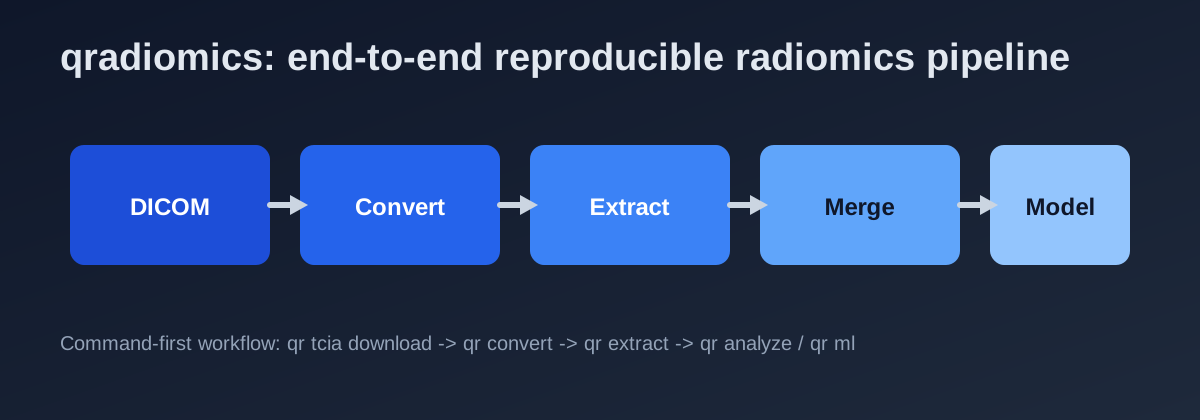
qradiomics workflow overview

Introducing qradiomics — A Unified Radiomics CLI for Reproducible Research

We are releasing qradiomics — an open-source Python CLI that unifies more than a decade of Choi Lab radiomics work into a single, reproducible, pip-installable toolkit. What is qradiomics? qradiomics (command: qr) is a radiomics research CLI built for the full data flow from raw DICOM to published-grade results: DICOM download → conversion → feature extraction → clinical merge → modeling Each step is a single Unix-style command. Pipelines are assembled from those atomic commands using plain JSON plans, executed by Nextflow (per-patient parallel), Prefect, or inline. One command gets you started: ...

May 20, 2026 · 5 min · 900 words · Wookjin Choi

qradiomics — Radiomics Research CLI

License: MIT · Python: 3.11+ · Version: 0.9.0 · Repo: choilab-jefferson/qradiomics Active successor for three earlier Choi Lab radiomics codebases. The C++/MATLAB pipelines in taznux/radiomics-tools, taznux/lung-image-analysis, and choilab-jefferson/LungCancerScreeningRadiomics are superseded by this repo. The feature extractors are now in qradiomics.feature.rtools (Python ITK port, numerically exact to the C++ binary). New work should land here. Radiomics research CLI. qr does two things equally well: Atomic tasks — convert DICOM, extract features, merge clinical, fit a model. Each is a single command, files in / files out. Workflow assembly — generate, mutate, scaffold, and run multi-step pipelines from those atomic tasks. Default executor is Nextflow (per-patient parallel + cache + HPC); Prefect is the secondary executor; inline is the small-cohort fallback. The canonical radiomics data flow has four stages — data → image → features → modeling — and one qr workflow plan call instantiates the whole chain: ...

May 17, 2026 · 14 min · 2874 words · Wookjin Choi